Keleuo

Open source desktop app

Your coding agents, with your project beside it.

A small, very fast desktop app for coding agents. Each session is its own workspace, and you can see at a glance which are working and which need you.

See the app Download

The name comes from the Greek keleuo, "to command, to urge". You direct, the agent builds, and you watch it come together.

Keleuo assembling a workspaceAn isometric voxel scene. The little cube cursor from the Keleuo icon stands on a periwinkle platform, beside a billboard with the app icon, while a golden crane lifts blocks labelled Sessions, Skills, Agent, Code and Terminal into a row, one by one, until the workspace is complete. Two status tags read: Fix login bug, working; Release notes, needs you.SessionsSkillsAgentCodeTerminal>_Fix login bug · workingRelease notes · needs you
A workspace, one block at a time.

What Keleuo looks like

The Keleuo window. On the left, a list of sessions with their folder and branch. Next to it, the project's file tree and an Agent panel listing earlier sessions in this folder. On the right, the agent chat: a request to run two subagents, each shown as a collapsible card with its tool calls, then the agent's summary, and an Edit card with a red and green diff of greet.py.
  1. 1Sessions Each one keeps its own folder, branch, conversation and layout.
  2. 2Project Files, skills and earlier sessions for the folder you are in.
  3. 3Agent Tool calls as cards, subagents as they run, real diffs.

Why it exists

I love Claude Code. I just found it a lot to take in.

It moves fast and says a lot, and I kept losing track of what it had actually changed. Editors with an agent built in are good too, but there the agent is a panel beside the file. Keleuo puts the agent first and keeps the code right next to it, so I can follow the work and still put my own hands on it. The terminal is always one click away.

Why I made it, in full · What changed today

What it adds on top

The terminal, plus a few layers.

A readable view of the same session

Chat view shows the session as it happens: markdown rendered, tool calls folded into cards, real diffs, file:line references as links, subagents as they run. Terminal view is Claude Code itself, for slash commands and everything else. Both show the same running process, so nothing restarts when you switch.

Choose a view
Chat view: the request "Reply with just the word ok." and the answer, ok, in the chat style, with the model name above. Terminal view of the same session: Claude Code's own screen, with its banner, the same request and answer, and a line reading Baked for 1s. The working folder path is blurred.

Questions you won't miss

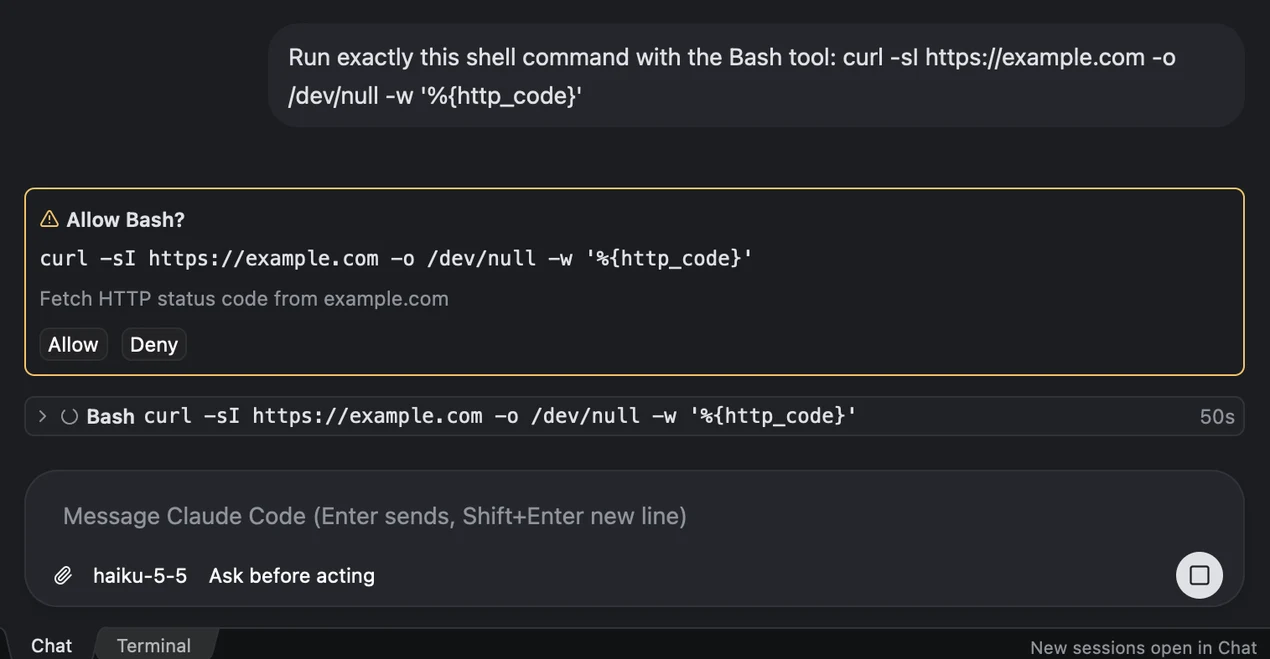
When Claude asks to run a command, the request shows in the chat with the exact command and Allow and Deny buttons. The session's dot in the list turns yellow, so you see it from whatever else you are doing.

A permission prompt in the chat, titled Allow Bash?, showing the exact curl command the agent wants to run, a short description, and Allow and Deny buttons. The tool call waits below it with a spinner.

Several sessions, one glance

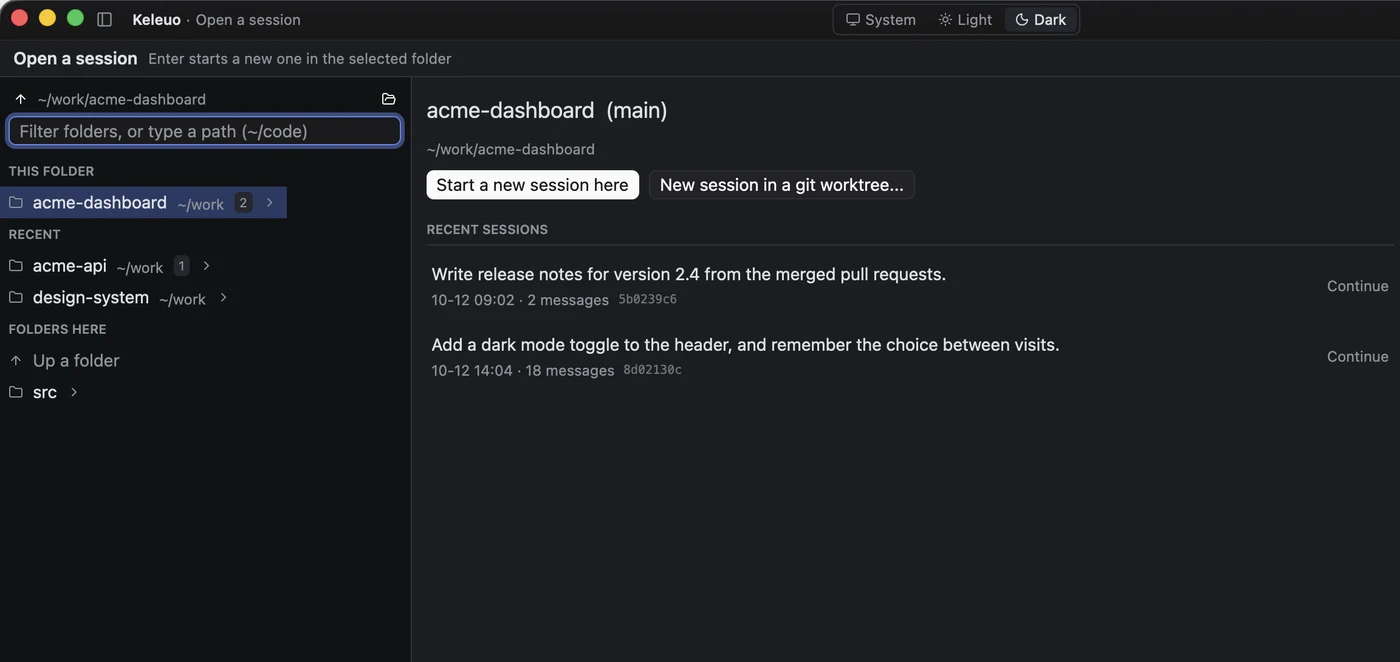
Each session keeps its own folder, conversation, terminals and layout, with a dot for working, waiting on you, or done. Open a folder to see the sessions that ran there; continue one, fork it, or start fresh in a git worktree.

The session browser for a project folder: recent folders with their session counts on the left, and on the right the folder's most recent sessions, each with a Continue button, plus buttons to start a new session or one in a git worktree.

The skills it will use, readable

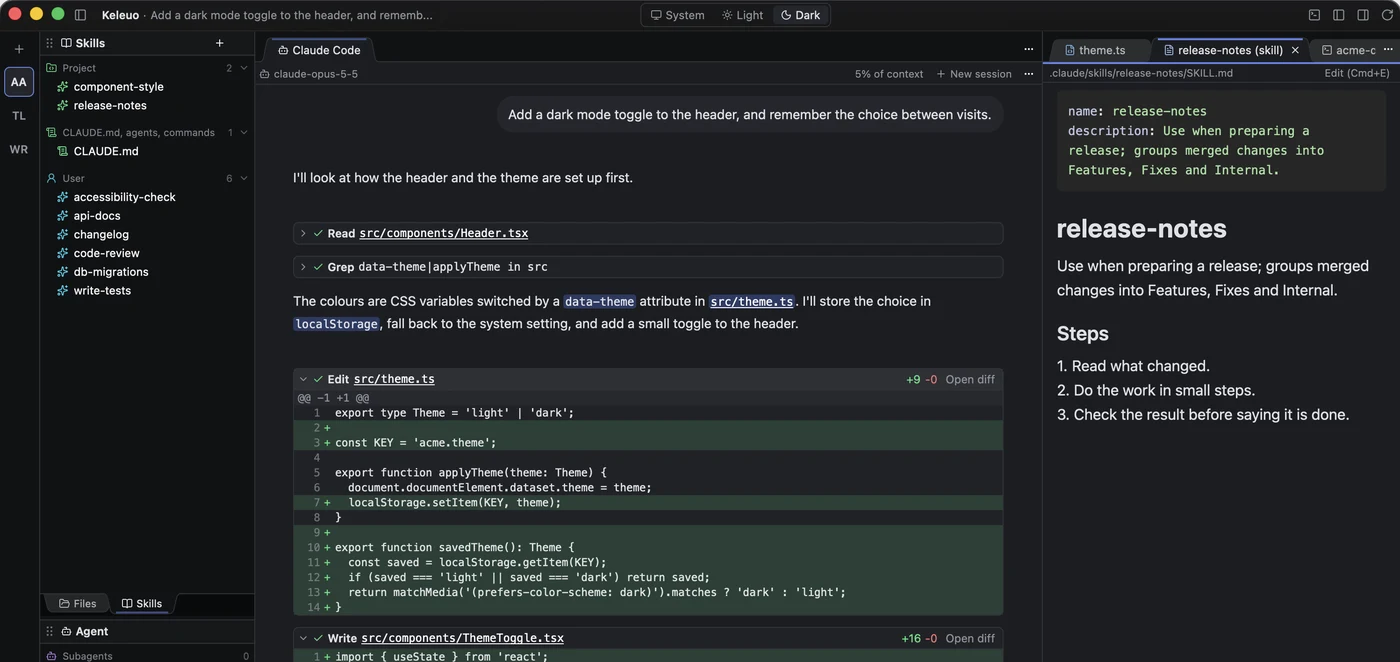
Every skill the project can use, from the project, your user folder and installed plugins, in one panel. Open one to read it beside your work, or edit it in place.

The skills panel lists project and user skills. The conversation is in the middle, with file reads and edits as cards, and a release-notes skill file is open on the right, rendered with its name, description and steps.

Check the work where it happened

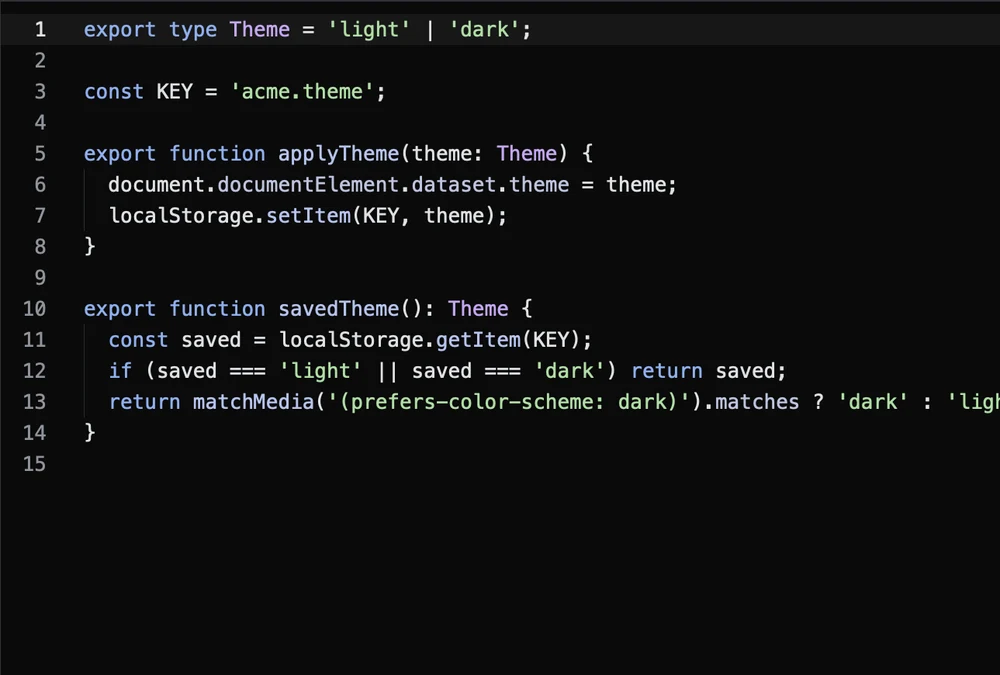
A file tree, an editor with syntax highlighting and go to definition, and real terminals, in the same window as the session. Panels dock and split by drag and drop.

The editor showing a TypeScript file, theme.ts, with syntax highlighting and line numbers: a type, a constant, and two functions that save and apply the theme.

Where it stands

Early, and used every day.

Works today

  • Sessions as workspaces with live status
  • Chat and Terminal views of one process
  • Permission prompts, diffs, subagents
  • Skills, file tree, editor, terminals
  • Continue, fork and worktree sessions

Rough edges

  • macOS only for now
  • Claude Code is the only agent so far
  • No download yet

Next

  • Remote sessions over SSH
  • More coding agents
  • Downloads and the public repository

Open source · Apache 2.0

Made for my own work. Yours to use and change.

Keleuo is free and open source. It is written in Rust on gpui, the framework behind the Zed editor, with no browser engine inside, so it stays small and quick.

If it helps you, I would love to hear about it. Issues, ideas and pull requests are welcome.